Blogs
Critical Telnetd Vulnerability Enables Unauthenticated Root Access
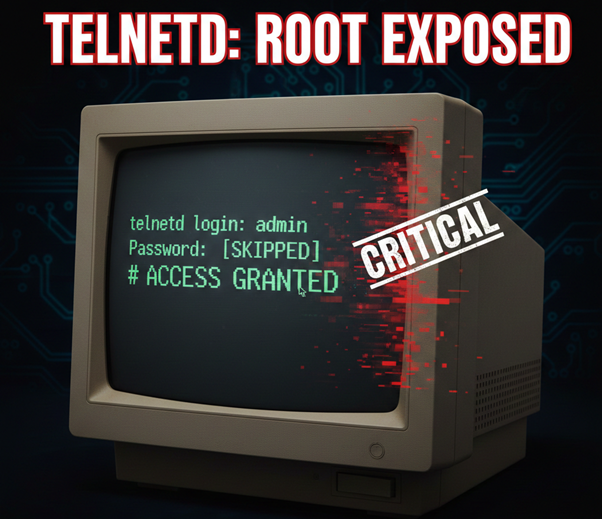
CVE-2026-24061 is a critical authentication bypass vulnerability in the GNU InetUtils telnetd service that enables remote, unauthenticated attackers to obtain root-level access. The vulnerability originates from improper handling of user-supplied environment variables during the Telnet login process. Specifically, telnetd forwards the USER environment variable directly to the system /usr/bin/login binary without sufficient validation or sanitization.
An attacker can craft a malicious Telnet connection that injects arguments such as -f root into the USER variable. When passed to the login process, this argument is interpreted as a trusted authentication flag, causing the login mechanism to assume the user has already been authenticated. As a result, authentication checks are bypassed entirely, granting immediate privileged access. This behavior occurs prior to credential verification, making the vulnerability exploitable without valid usernames or passwords.
The flaw affects GNU InetUtils versions 1.9.3 through 2.7 and has been present in the codebase for approximately 11 years. Due to the legacy nature of Telnet, the vulnerable service often remains enabled on systems that are not routinely audited, including embedded devices, legacy Linux servers, network appliances, and operational technology environments. In such deployments, telnetd frequently runs with elevated privileges, increasing the impact of successful exploitation.
Public proof-of-concept exploits confirm that exploitation is reliable and low complexity when the Telnet service is network-accessible. Post-disclosure activity indicates active scanning and exploitation attempts targeting exposed Telnet services, positioning this vulnerability as a viable initial access vector for full system compromise.
Mitigation requires immediate decommissioning of Telnet services wherever possible. Systems that cannot remove Telnet must apply vendor patches, restrict network access to the service through segmentation and filtering, and implement monitoring for Telnet-related activity. CVE-2026-24061 demonstrates that legacy services continue to pose significant security risks and should be treated as high-priority findings during vulnerability assessments and continuous monitoring operations.
Supporting Links:
1. https://nvd.nist.gov/vuln/detail/CVE-2026-24061
2. https://www.cyber.gc.ca/en/alerts-advisories/al26-002-vulnerability-affecting-gnu-inetutils-telnetd-cve-2026-24061